Local AI · DGX Spark
AI Music & SFX Studio
Describe it once, get a usable BGM loop or sound effect back.
Stable Audio Open running locally — an asset generator, not a song generator.
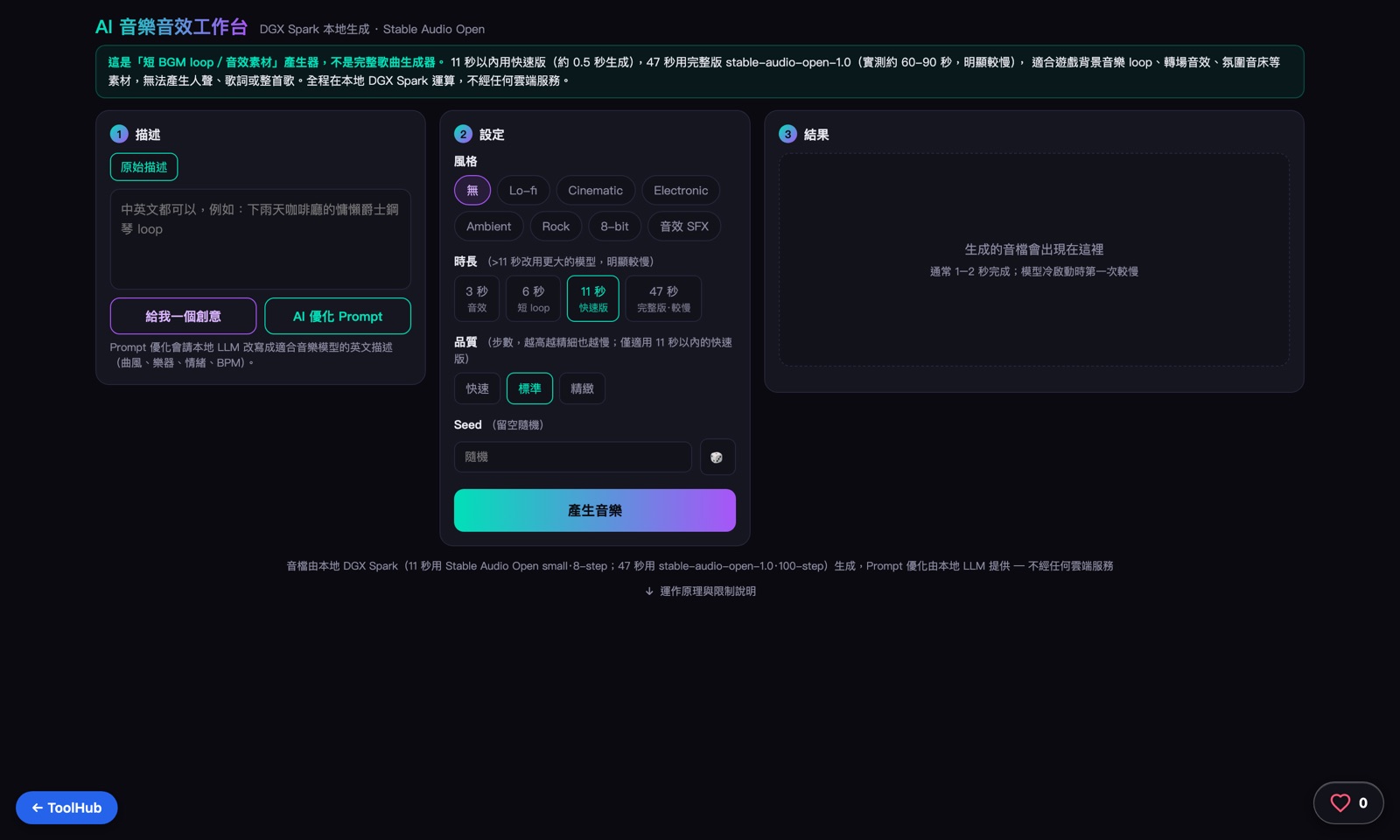
The live interface — captured with Playwright
Why build one
Finding royalty-free music beds and sound effects is a bottomless pit — licensing to check, styles that never quite fit, and cloud AI music generators mean paying per clip, waiting in a queue, and shipping your data out the door. When a slide deck or demo needs a sound effect right now, you can't afford the wait.
There was an idle GPU on the DGX Spark at home. Stand up Stable Audio Open, type one description, and it generates locally — free and private.
What actually took more care was positioning: this tool generates BGM loops and sound effects, not full songs. Setting that expectation early keeps people from reaching for the wrong tool.
How it works: the journey of one clip
From one description to a stereo WAV — four things happen in between.
A description arrives, in Chinese or English
Users describe the music or sound effect they want in either language — no translation step required.
A local LLM refines the prompt
A local language model rewrites the plain description into something the audio model understands — filling in rhythm, mood, instrumentation and atmosphere, so people with no music-production vocabulary still get a fitting result.
Style and length pick the fast or full model
Once the user sets a style and length, the request routes to one of two models: the fast version (small) renders 11 seconds of audio in about 0.5 seconds — great for rapid iteration; the full version (1.0) renders 47 seconds with fuller quality, at a cost of roughly 60–90 seconds of generation time.
Stable Audio Open renders a stereo file
The model runs inference locally on DGX Spark and outputs a stereo WAV directly — ready to drop into a slide deck, video, or game as a music bed or sound effect.
Deep dive: the fast-vs-full model trade-off
Both paths share the same LLM prompt-refinement step — all the difference happens at the audio diffusion model.
Description input
Chinese or English
/api/musicgen/optimize
Local LLM fills in detail
rhythm / mood / instrumentation / atmosphere
stable-audio-open-small
Fast tier・8-step pingpong sampling
11s output・~0.5s generation
stable-audio-open-1.0
Full tier・100-step / cfg 7 / dpmpp-3m-sde
47s output・~60–90s generation
44.1kHz stereo WAV
Output
returned as base64
ready to download
Fast tier vs. full tier
small: an 8-step distilled model with no inpaint conditioning — segment-and-extend was tested and collapses into silence, so no extend mode is offered
1.0: the official-recommended 100-step / cfg 7 / dpmpp-3m-sde, over 100× slower than small
short durations (3/6s) are trimmed from the 11s fast output; the 47s tier offers no trimming — use the 11s-or-under tier for short effects
11s
fast (small) output length
~0.5s
fast version generation time
47s
full (1.0) output length
60–90s
full version generation time
Key design decisions
Local-first, no cloud round trip
Generation happens entirely on DGX Spark — music and sound assets never get uploaded to a third-party service.
Two-tier model choice: fast vs. full
The fast model (small) renders in seconds — great for iterating on an idea; the full model (1.0) delivers fuller quality and length for the final asset.
Framed clearly as an asset generator, not a song generator
The output is BGM loops and sound effects, not finished songs. Setting that expectation up front keeps people from asking it for a complete track.
LLM refinement lowers the bar for describing sound
Users don't need music-production vocabulary — a local LLM turns a plain description into something the model understands, in either Chinese or English.
Architecture
Frontend
Chinese/English input
style / length selection
stereo WAV download
LLM
Local model refines the prompt
Chinese or English input
style-tag fusion
Inference
Stable Audio Open
small (fast) / 1.0 (full)
local inference on DGX Spark
Output
Stereo WAV
11s (fast) / 47s (full)
ready to download and use
The live tool is locked behind Basic Auth — this page shares the architecture and design.