IoT · 3D Printing · Firmware
Server-Room Climate Monitor
One request, running in the server room about 14 hours later.
ESP32 + DHT11, a home-printed sliding-lid case, firmware that only serves an API.
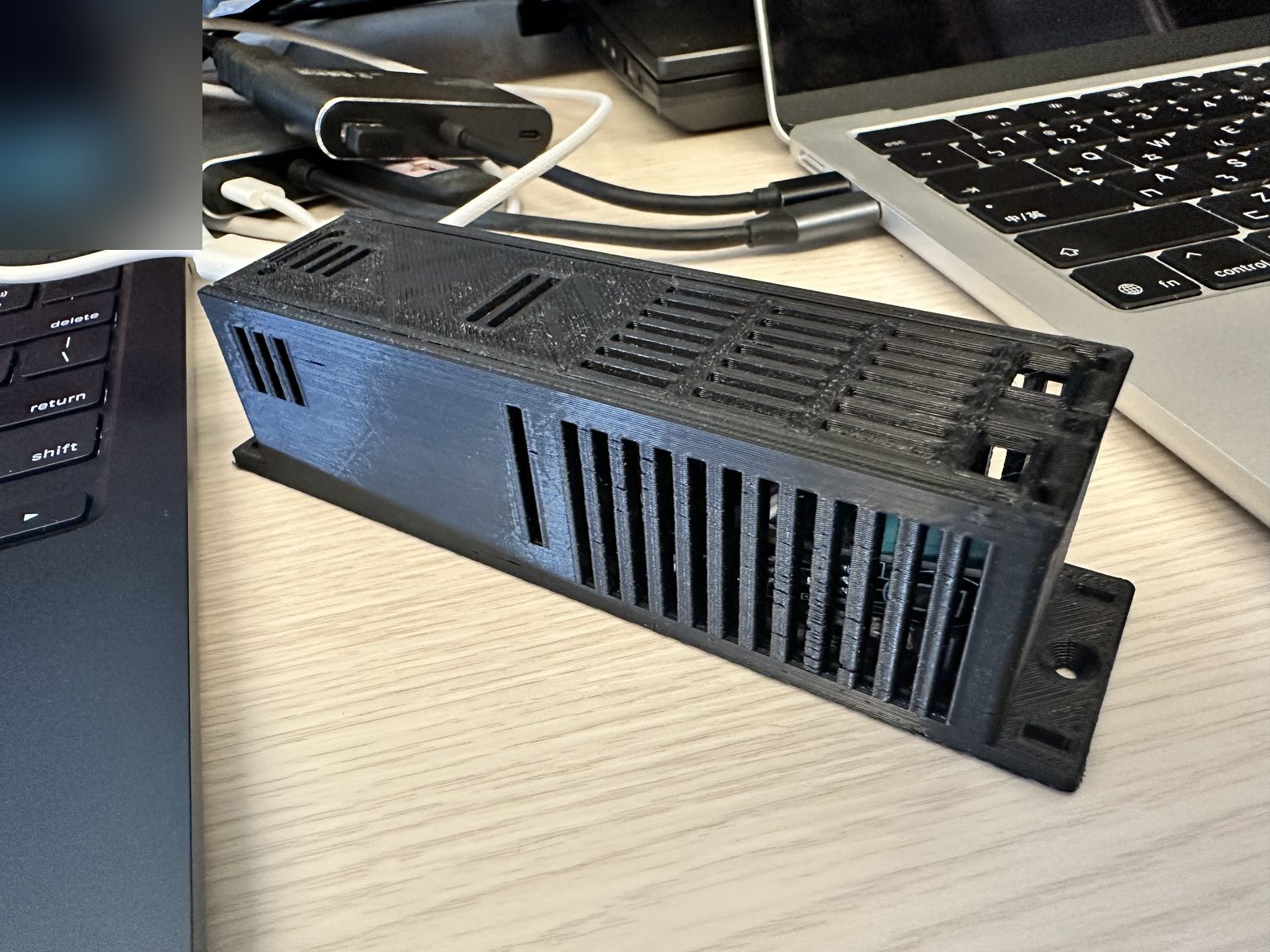
The real device, lid closed and running · background screen blurred
It started with one sentence
The server room needed a temperature and humidity sensor that could be read over the network. The scope was narrow from the start: measure only, no control of dehumidifiers or humidifiers; USB 5 V power; a case printed in PLA on the Ender‑3 at home.
The device only serves an API. Whether to alert and how long to keep data is decided by a separate polling service, so adding a sensor or changing a threshold never means reflashing.
I bought the parts, printed, wired and assembled it myself. AI implemented the wiring diagram, the CAD model, the firmware and the dashboard, each from a written brief with its scope and acceptance criteria.
From request to running
Four turns along the way: new hardware, an unknown board size, two swapped wires, and “alert on the device” becoming “measure only”.
Parts: whatever was actually bought
The plan was an ESP32‑C3 with an SHT31. The same day it became the ESP32 board and DHT11 an electronics shop had on the shelf. The BOM follows the real parts, with prices compared against equivalent items online.
Wiring: drawn from an existing parts library
Wokwi's open-source elements (MIT) were rendered in a headless browser, and every wire ends on the part's own pin coordinates. Three wires: 3V3, GND, GPIO4.
Model: a parametric OpenSCAD case
Body and lid print on one plate with no supports. The board came home in a bag, 30-pin or 38-pin unknown, so both versions were built, each with 15 automated checks.
Slicing: three rounds of G-code
Cura, PLA, 0.28 mm layers, about 6 hours per plate. The last round added a brim, a hotter bed and no fan for the first 3 layers, so the long, thin parts are less likely to warp.
Firmware: measure and serve
One sample every 5 seconds, about an hour kept in RAM; endpoints for latest, incremental history, health and Prometheus-format metrics. The core logic was tested on the host before it ever reached the board.
Closing the loop: two swapped white wires
The first flash read nothing. A diagnostic sketch found the data pin pulled to ground, which pointed to two same-colored wires swapped at the module. After swapping them back: 923 readings in a row on the dashboard, zero failures.
The sliding-lid case
A 45° dovetail lid slides out toward the USB end; vented walls, clear space over the antenna, and the cable and BOOT/EN buttons reachable without opening it.
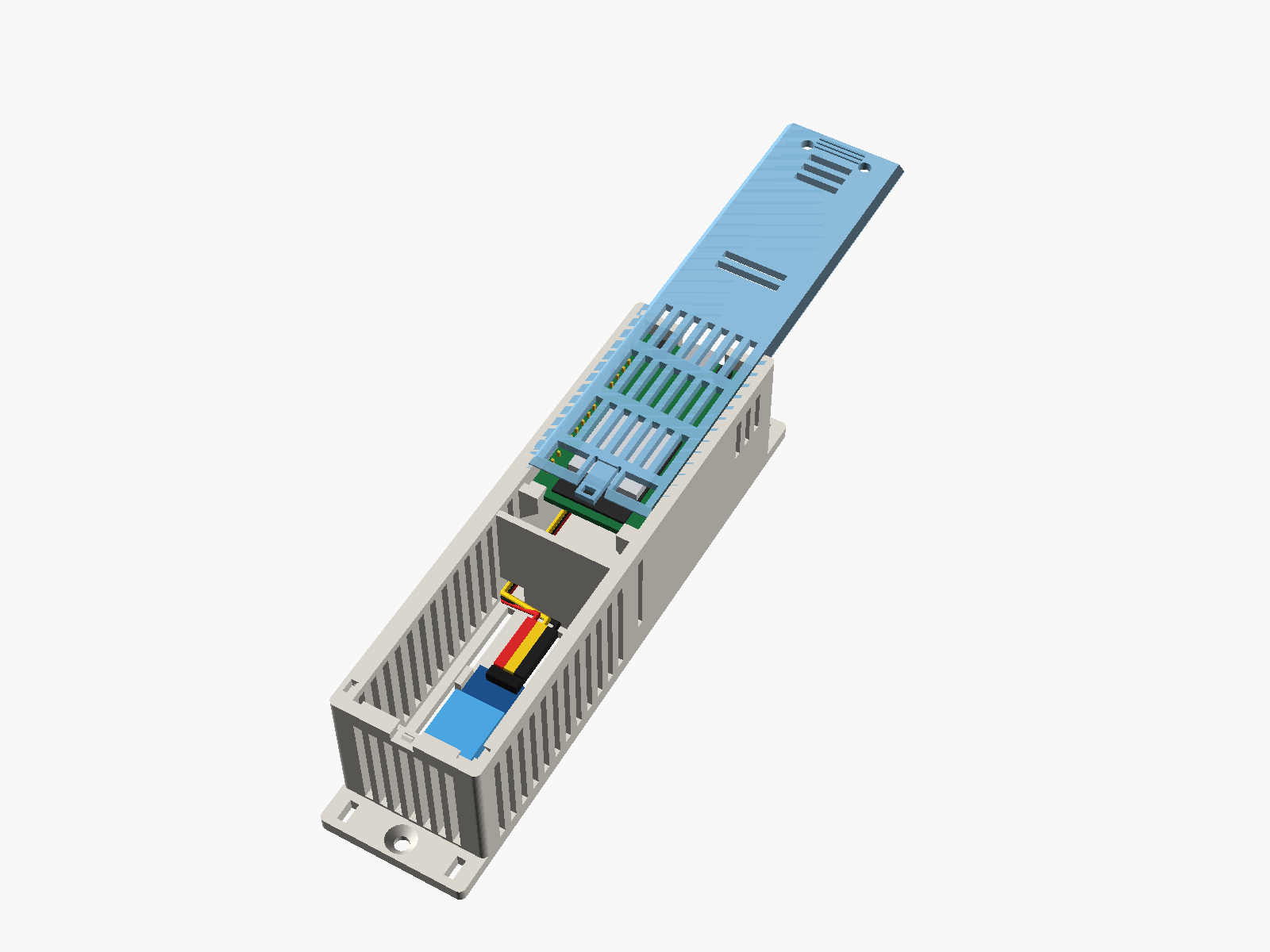
30-pin version, lid half open (the full write-up has a 3D model you can rotate and slide open)
~14h
request to running
923
readings · 0 failed
15
automated case checks
181+47
host-side tests
Key design decisions
The device measures; a service decides
The first firmware alerted on the device. That was taken out, leaving raw values and health counters. Thresholds, alert channels and retention change on the service side, with no reflash.
Mark what is uncertain, build both
Every dimension is labeled as official, third-party measured or estimated. With the board size unknown, a 30-pin and a 38-pin case were both built instead of treating a guess as settled.
Checks have to be able to fail
Both the case checks and the firmware tests were deliberately broken once to prove they catch errors; on-device acceptance had its own checklist.
The API stays on a trusted LAN
There is no login and only plain HTTP, so it is never exposed to the internet; reaching it from another network goes through a VPN. A Bearer token can be added later, and CORS already allows the Authorization header.
Tech
Hardware
ESP32 30-pin DOIT DevKit V1
DHT11 module
Jumper wires, no soldering
CAD / Print
OpenSCAD (Manifold)
Python interference checks
Cura 5.6 · layer-by-layer G-code review
Firmware
arduino-cli · ESP32 Arduino core
C++ host tests (ASan / UBSan)
NTP · Prometheus format
Dashboard
One HTML file calling the API
Displays only, never judges
Verified on the device with Playwright
The BOM and price comparison, wiring diagram, rotatable 3D model, G-code, API and closing evidence are in the full write-up (in Chinese).